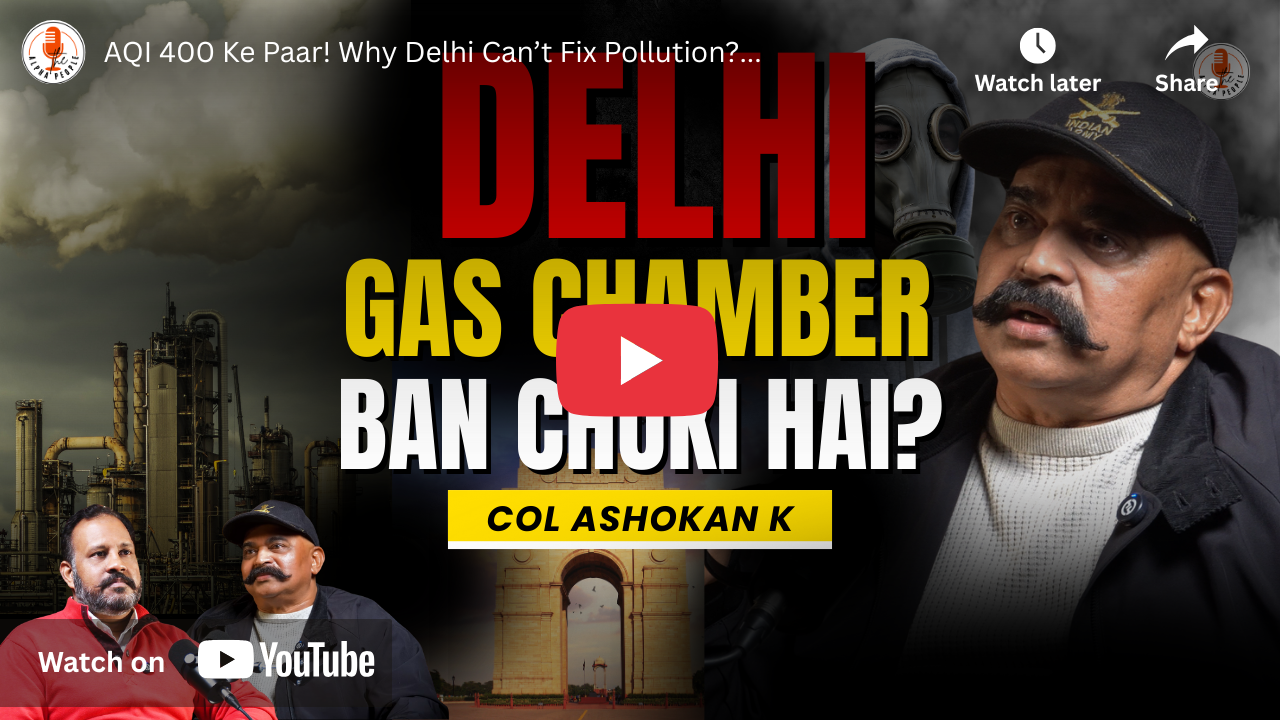
This powerful episode of The Alpha People Podcast dives deep into the Delhi pollution crisis, where AQI 400+ has shockingly become the new normal. Colonel Ashokan explains why air pollution in Delhi NCR is no longer a seasonal issue but a structural and geographical problem. He highlights how Delhi’s landlocked, bowl-like geography traps polluted air, making the capital highly vulnerable compared to coastal cities like Mumbai or Chennai.
A major focus of the discussion is the misplaced blame game around stubble burning. While crop residue burning in Punjab and Haryana does contribute to pollution, the podcast reveals that even during COVID lockdowns—when vehicles, industries, and stubble burning were almost zero—Delhi still recorded many severe AQI days. This exposes a deeper issue linked to urban design, dust, PM 2.5 particles, and stagnant air.
Colonel Ashokan compares India’s approach with China’s pollution control model, especially Beijing’s transformation. China reduced AQI drastically by switching to electric public transport, cutting coal dependency, controlling construction dust, increasing urban afforestation, and enforcing strict long-term policies like permanent odd-even rules. The key takeaway: pollution control needs consistent, long-term execution, not knee-jerk actions.
The podcast strongly emphasizes the health impact of PM 2.5, calling it the most dangerous pollutant as it enters the lungs and bloodstream directly, leading to respiratory and heart diseases. Rising cases in hospitals, shortage of medicines, and increasing impact on children (Gen Alpha) make this a public health emergency, not just an environmental concern.
Another hard-hitting segment discusses citizen responsibility. Pollution is not only a government failure but a reflection of public behavior—excessive vehicle use, littering, lack of civic sense, and indifference. Examples like Japan’s cleanliness culture and India’s own “Ugly Indians” movement show how mindset change at the grassroots level can create visible transformation.
The episode concludes with a clear message: Delhi’s pollution crisis is a national shame and a collective responsibility. Lip service, temporary bans, and political blame will not work. What India needs is urban planning reform, green spaces (city lungs), public awareness, and citizen-led action—starting now, before it’s too late.
🔔 Don’t forget to subscribe & share if this conversation resonated with you!
🔔 Don’t forget to subscribe & share if this conversation resonated with you!
Frequently Asked Questions
Certainly! Here are some potential questions and answers based on the podcast conversation: