Series 2: Saudi–Pakistan Military Pact
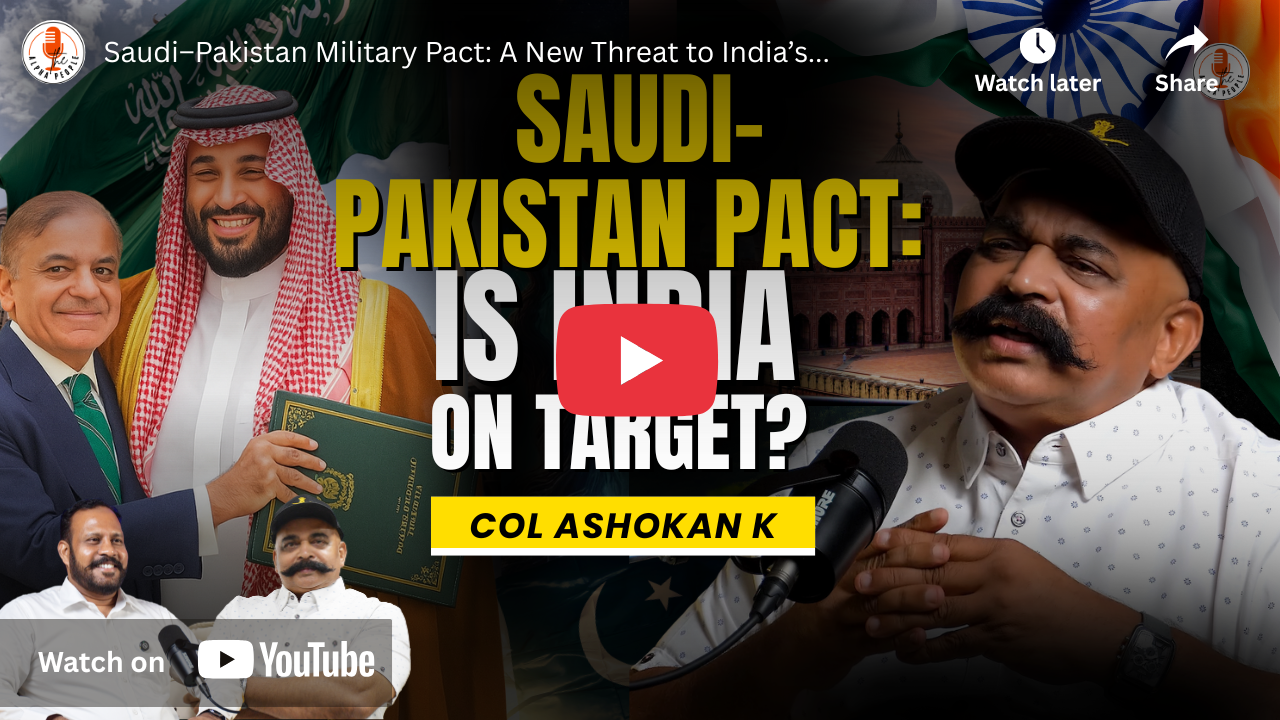
In this podcast episode, Colonel Ashokan explains the geopolitical shock created by the sudden Saudi–Pakistan military pact, a NATO-style agreement where an attack on one country will be treated as an attack on both. This development surprised India because Saudi Arabia has historically been one of India’s closest allies in the Middle East. The Colonel highlights that the pact reflects a major shift in regional security thinking, triggered largely by the recent Israel–Hamas conflict and the belief among Middle Eastern nations that the United States can no longer be relied upon for protection. When Israel conducted a strike inside Doha, Qatar, without American intervention, the defense umbrella traditionally assumed by Gulf nations seemed broken, prompting them to seek new alliances.
Colonel Ashokan emphasizes that the pact’s biggest implication is Pakistan’s role as the only Islamic nuclear power, which gives Saudi Arabia access to a form of nuclear deterrence. This elevates Pakistan’s strategic value despite being economically unstable. He explains that Pakistan benefits immensely because it now gains renewed attention and support not only from Saudi Arabia but also from global rivals like China and the United States. China views Pakistan as a key part of its Belt and Road corridor and a tool against India, while the U.S.—especially under Donald Trump—has economic and political interests tied to Pakistan’s rare-earth claims and crypto-currency ecosystem.
The Colonel also discusses Pakistan’s exaggerated claims about rare-earth minerals, noting that although small deposits exist, they are not commercially viable and are located in violently contested regions like Balochistan. Despite this, Pakistan uses these claims to attract American investment and geopolitical support. He further warns that China, which has invested billions in CPEC, will never allow Pakistan to open the region to U.S. mining operations. This places Pakistan in a unique but unstable position—benefiting from the interests of multiple superpowers while lacking internal stability.
The episode concludes by analyzing how this pact could indirectly affect India’s security and regional ambitions. If Pakistan were to orchestrate another terror attack, India’s military response could now pull Saudi Arabia into the conflict due to the pact. Additionally, new Islamic military alignments could threaten India’s strategic projects in the Middle East, including the I2U2 coalition and IMEC economic corridor. Colonel Ashokan stresses that India must watch this development closely, as a nuclear-backed, financially supported Pakistan could reshape future conflict scenarios in the region.
The Colonel highlights how China, the U.S., and Saudi Arabia are using Pakistan as a strategic pawn — each for their own interests:
- China for the CPEC corridor and access to the Arabian Sea.
- U.S. for controlling rare-earth resources and cryptocurrency networks.
- Saudi Arabia to gain military and nuclear backing amid Middle East tensions.
He warns that this pact could evolve into an Islamic military bloc of 50+ nations, posing complex challenges to global stability and India’s neighborhood diplomacy.
Key Takeaway:
The pact symbolizes a new geopolitical chessboard where Pakistan becomes a conduit between China’s strategic expansion, America’s economic ambitions, and Saudi Arabia’s regional security needs.
🔔 Don’t forget to subscribe & share if this conversation resonated with you!
🔔 Don’t forget to subscribe & share if this conversation resonated with you!
Frequently Asked Questions
Certainly! Here are some potential questions and answers based on the podcast conversation:
The Saudi–Pakistan military pact is described by Colonel Ashokan as a NATO-style agreement where an attack on one nation will be treated as an attack on both. This is highly significant because Saudi Arabia has traditionally been a close ally of India, sharing long-standing diplomatic friendship, cultural engagement, and even allowing Hindu temples within its territory. The sudden announcement that Saudi Arabia will now militarily support Pakistan shocked India and the world, as it signals a major shift in Middle Eastern geopolitical alignments.
According to the Colonel, Saudi Arabia’s trust in the United States' protection collapsed after Israel launched a targeted strike on Hamas leadership inside Doha, Qatar—a clear violation of sovereignty—without any American intervention. For decades, Middle Eastern nations operated under an assumption that the U.S. defense umbrella would shield them from such external threats. When this belief was shattered, regional nations began reconsidering their strategic dependencies. As a result, Saudi Arabia may have felt compelled to create new military alliances within the Islamic world, and Pakistan—with its large military and nuclear arsenal—was the most viable partner.
Pakistan is the only Islamic nation possessing nuclear weapons, making it uniquely valuable in the eyes of Saudi Arabia. Colonel Ashokan explains that Pakistan has already signaled willingness to extend a “nuclear umbrella” over Saudi Arabia, which dramatically increases the strategic weight of their partnership. In a region where nations perceive threats from both Israel and Iran, access to nuclear deterrence—even indirectly—elevates Pakistan’s importance and makes the pact far more consequential for regional security dynamics.
Pakistan has long claimed to possess rare-earth minerals in areas like Balochistan and Khyber Pakhtunkhwa, which are essential for semiconductors, missile systems, and modern weaponry. However, as the Colonel clarifies, although some deposits exist, most international companies abandoned mining the region because the minerals were of insufficient quality and extraction was commercially unviable. Despite this, Pakistan is using these claims to attract American interest, especially since the U.S. seeks to reduce dependence on China—which currently dominates global rare-earth production.
If a Pakistan-backed terror attack similar to Pahalgam or Pulwama were to occur again, India would naturally be compelled to retaliate militarily. Under this new pact, Saudi Arabia would be obligated—at least politically if not directly militarily—to support Pakistan, instantly transforming what would normally be a bilateral India–Pakistan conflict into a broader confrontation involving a major Middle Eastern power. Colonel Ashokan warns that this adds a dangerous new dimension to South Asian security because Saudi Arabia brings immense financial strength while Pakistan already enjoys China’s military support.
Colonel Ashokan explains that Pakistan remains valuable because global powers see it as a tool to further their own strategic interests. China uses Pakistan to access the Arabian Sea through the China–Pakistan Economic Corridor (CPEC) and to counterbalance India's growing influence. The United States, particularly under Donald Trump, has separate motives, including personal and national interests in Pakistan’s crypto-currency ecosystem and the hope of accessing rare-earth deposits. Thus, Pakistan’s economic failures do not diminish its strategic utility to these powers.
Pakistan sits at a critical crossroads connecting South Asia, Central Asia, and the Middle East. Historically, during the Cold War, Pakistan served as a crucial American ally by assisting Afghan fighters against Soviet forces, which earned Pakistan enormous military and financial support from the U.S. Its proximity to Afghanistan, access to ports like Gwadar, and its role as China’s gateway for the Belt and Road Initiative make it indispensable for international powers seeking influence in the region. This geopolitical positioning explains why Pakistan continues to receive global attention and support despite internal instability.
India had recently entered several promising regional partnerships, such as the I2U2 group (India–Israel–UAE–USA) and the India–Middle East–Europe Economic Corridor (IMEC). Both initiatives depended on a stable and cooperative Middle East. However, the outbreak of conflict between Israel and Hamas, followed by Saudi Arabia’s strategic realignment with Pakistan, has disrupted these long-term Indian plans. As the Colonel notes, this introduces uncertainty into India’s economic and geopolitical projects across the region.
Despite being a nation that has defaulted, borrowed repeatedly from IMF, and struggles to provide basic necessities to its population, Pakistan remains useful to global powers. The Colonel states that Pakistan is a “tool” in the hands of China, a geopolitical leverage point for the U.S., and now a nuclear partner for Saudi Arabia. Each of these powers finds Pakistan strategically beneficial—even if Pakistan brings instability—because they can use it to balance or pressure rival nations, especially India and Iran. This makes Pakistan’s failures less relevant to its global significance.