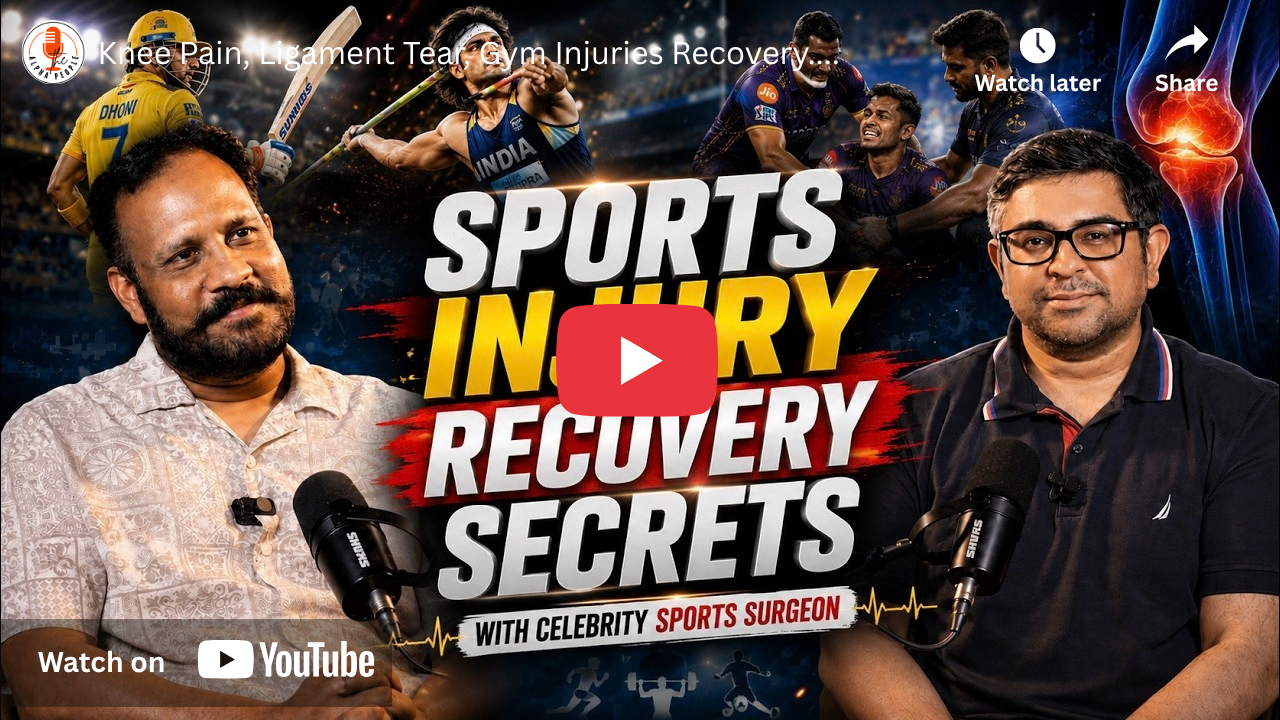
In this podcast, host and audience are introduced to Dr. Manit Arora, a leading orthopedic sports surgeon and joint health specialist who returned to Chandigarh after spending nearly two decades training in Australia, Japan, and France. He outlines the evolution of orthopedics from broad, general bone-and-joint treatment into precise sub-specialties like spine care, joint replacement, and sports surgery . Drawing from his clinical experience, he shares anecdotes of treating elite Indian athletes, including Olympic champion Neeraj Chopra for a shoulder issue , Indian hockey captain Harmanpreet Singh, national basketball and volleyball stars, IPL cricketers, and numerous top-tier Kabaddi and wrestling athletes .
The discussion delves deeply into sport-specific injuries and the biomechanics behind them. In high-impact, contact sports like Kabaddi and wrestling, competitors frequently suffer from severe knee ligament tears (ACL), meniscus damage, and shoulder or ankle dislocations due to violent twisting and non-contact pivots. Conversely, cricketers tend to present with repetitive-strain conditions, particularly rotator cuff issues from continuous throwing and lumbar spine injuries from bowling workloads. Dr. Arora notes that normal recovery following ligament reconstruction surgery typically requires 8 to 9 months , underscoring the risk of rushing back onto the field before biological healing is complete.
Highlighting the delicate balance between medical timelines and competitive ambition, Dr. Arora recounts operating on Harmanpreet Singh’s ACL and meniscus just six months before the Tokyo Olympics . While standard medical protocol advised against playing that soon, structured athletic rehabilitation and elite biological conditioning enabled him not only to participate but to finish as the tournament’s top goal scorer . Dr. Arora uses this case to stress the critical role of injury prevention protocols, highlighting grassroots frameworks like the FIFA 11+ warm-up program, which drastically reduces incidence rates of lower-limb ligament injuries when implemented consistently .
Addressing common gym and fitness culture pitfalls, Dr. Arora explains the clinical difference between good pain and bad pain . Good pain—commonly known as Delayed Onset Muscle Soreness (DOMS)—stems from healthy muscular micro-tears that resolve naturally with hydration, rest, and active recovery within two to three days . In contrast, bad pain is localized, sharp, persists for weeks, or escalates during sets, signaling structural joint damage, tendon micro-tears, or labral/meniscus lesions that require professional medical intervention .
A major concern raised in the episode is the rampant culture of unregulated self-medication in India. Many everyday gym-goers and athletes routinely pop muscle relaxants (MR pills) or pain relievers to numb training soreness. Dr. Arora warns that these medications cause systemic gastrointestinal and smooth muscle side effects and merely mask structural issues rather than fixing them. He similarly cautions against ignoring small injuries; individuals who walk off a torn ligament often return years later suffering from secondary meniscus tears, joint locking, and premature knee osteoarthritis caused by chronic mechanical instability.
Finally, the conversation emphasizes the importance of individualized conditioning and periodization over generic workout templates. Body composition and lifting regimens must match an athlete’s sport and role—such as heavy pulling strength and flexible hips for a wrestler versus core agility and lean speed for a cricketer. As seen with seasoned players like MS Dhoni, aging inherently slows cellular repair and blood perfusion in muscular tissues . To ensure long-term athletic longevity, modern teams increasingly rely on pre-medical screening camps, sports nutritionists, and sports psychologists alongside orthopedic surgeons and physiotherapists to preserve performance and prevent career-ending trauma.
🔔 Don’t forget to subscribe & share if this conversation resonated with you!
Frequently Asked Questions
Certainly! Here are some potential questions and answers based on the podcast conversation:
The body’s capacity to repair and heal decreases naturally with age as metabolism slows down. Activities and physical stress that a 20-year-old body can shake off overnight require far longer recovery in individuals aged 50 or 60 and above. When an older person overexerts themselves the day before, lingering morning stiffness is simply the body signaling that training volume and intensity need to match biological age.
Dr. Arora has treated several elite athletes across multiple sports, including Olympic javelin champion Neeraj Chopra (for a shoulder issue), Indian national hockey captain Harmanpreet Singh (ACL and meniscus reconstruction), the captains and vice-captains of the Indian national basketball and volleyball teams, multiple IPL and Ranji Trophy cricketers, and leading international Kabaddi and wrestli ng champions such as Ravi Deora, Faryad Ali, and Monu.
Standard recovery after surgical reconstruction of a knee ligament (such as an ACL) takes around 8 to 9 months. The biggest mistake athletes make is returning to full-contact play too quickly before biological healing and muscular rehab are complete. Rushing the process significantly spikes the risk of re-rupturing the graft or sustaining secondary injuries.
Harmanpreet underwent surgery for an ACL and meniscus tear just six months before the Tokyo Games. Although standard medical advice strongly suggested 8 to 9 months of rest, he committed to an intensive, carefully supervised rehabilitation protocol at the national camp in Bengaluru. Backed by exceptional physical conditioning, he made the Olympic squad, finished as the tournament’s top goal-scorer, and went on to win World Player of the Year honors. While an inspiring exception, Dr. Arora stresses that such rapid returns carry immense risk and require elite anatomical resilience.
Yes, many contact and non-contact injuries can be prevented through structured neuromuscular warm-up programs. Dr. Arora highlights grassroots protocols such as FIFA 11+, which incorporates 11 specific dynamic exercises focusing on core stability, eccentric hamstring control, and landing mechanics. Studies have demonstrated that consistently implementing these basic warm-up drills drastically reduces the rate of severe ligament injuries.
- Good Pain (DOMS): General muscle soreness and stiffness following an intense workout. It indicates healthy muscle breakdown and tissue adaptation, usually subsiding within 2 to 3 days after giving that muscle group adequate rest.
- Bad Pain: Persistent, sharp, or joint-specific pain that does not fade after several days, worsens during subsequent exercise sets, or interferes with joint mechanics. This indicates structural injury—such as a tendon tear, labral lesion, or ligament damage—and warrants medical examination.
No, taking muscle relaxants on your own for routine gym soreness is strongly discouraged. Muscle relaxants affect smooth muscle tissue throughout the entire body, frequently causing systemic side effects like gastrointestinal issues and diarrhea. Rather than popping pills to numb soreness, you should allow the muscle group 2 to 3 days of natural rest to evaluate whether the pain resolves on its own.
Even with a torn ligament, many individuals find they can walk normally after 10 to 15 days once initial swelling subsides. However, the knee joint remains mechanically unstable. Over 2 to 3 years, chronic abnormal joint sliding causes progressive damage to the articular cartilage and shock-absorbing meniscus. Eventually, the torn meniscus can displace and lock the joint completely, turning a simple, repairable injury into severe early-onset osteoarthritis that requires complex surgery.
Muscle tissue and ligaments heal via natural biological processes driven by local blood supply, and there is no surgical shortcut to artificially speed up muscle fiber healing. As athletes age, metabolic turnover and blood perfusion decline. Decades of heavy athletic wear—combined with previous micro-tears, loose joint bodies, or partial meniscus tears—inevitably compound, reducing agility and demanding longer downtime between injuries.
No. Strength training and body composition must be tailored strictly to the athlete’s sport, specific playing position, and biomechanical demands. For example, a wrestler requires strong pulling muscles, significant upper-body mass, and hip mobility to control opponents, whereas a fast bowler needs lean power and flexibility rather than excess bulk, which can be counterproductive. Even across professions, different physical demands require distinct conditioning—fine-motor specialists like neurosurgeons avoid heavy muscle bulk to prevent tremors, while orthopedic surgeons rely heavily on physical upper-body leverage.