Series 1: Why Was Sonam Wangchuk Arrested?
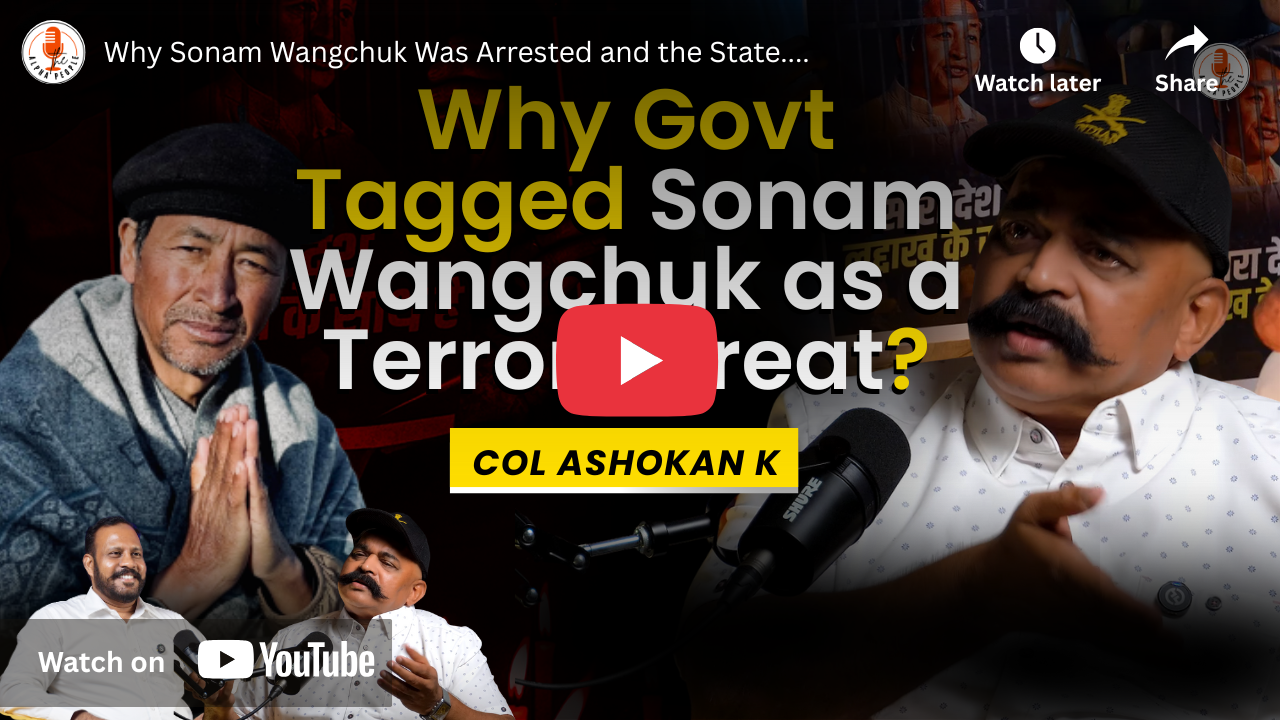
This episode explores the Ladakh agitation and the arrest of environmentalist and innovator Sonam Wangchuk.
Colonel Ashokan explains that Ladakh, once fiercely patriotic, is now witnessing youth unrest due to unemployment, cultural dilution, and environmental stress. Wangchuk’s protests for statehood, environmental protection, and Schedule Six status for Ladakh stem from genuine local grievances — yet, external elements might be exploiting the situation for geopolitical gains.
The Colonel emphasizes that foreign powers could be funding or manipulating small protests to destabilize the region, using social media to amplify tensions. He also criticizes the use of the National Security Act (NSA) against Wangchuk, warning that alienating Ladakhis — who are critical for India’s northern defense — could create long-term strategic vulnerabilities.
Key Takeaway:
A local agitation with legitimate concerns can be weaponized by external powers, reflecting how micro-level unrest connects to macro-level geopolitics.
In this three-part podcast series with Colonel Ashokan, The Alpha People Podcast dives into current geopolitical developments shaping India and the world. From domestic unrest in Ladakh to the Saudi–Pakistan military pact and the growing influence of Gen Z–led movements across nations, each episode explores how social, political, and economic forces are interlinked globally. The discussions reveal patterns of manipulation, global funding, and foreign interference that use economic instability and youth frustration as tools of power politics.
🔔 Don’t forget to subscribe & share if this conversation resonated with you!
🔔 Don’t forget to subscribe & share if this conversation resonated with you!
Frequently Asked Questions
Certainly! Here are some potential questions and answers based on the podcast conversation:
The agitation began over Ladakh’s demand for statehood and inclusion under the Sixth Schedule of the Constitution, which provides autonomy for tribal regions. Locals felt they lost administrative and financial powers after becoming a Union Territory.
Colonel Ashokan explains that Ladakhis are deeply patriotic but frustrated due to unemployment, loss of grazing lands, and fear that outside investors will erode their culture and environment.
- Full statehood for Ladakh.
- Implementation of the Sixth Schedule for tribal and environmental protection.
- Creation of a separate Public Service Commission for local employment.
According to Colonel Ashokan, the movement had been peaceful for six years, but suddenly turned violent—BJP offices and government buildings were attacked, and four people were killed.
He suspects that external elements or “vested interests” may have infiltrated the protest, providing funding and coordination, similar to “toolkit-style” movements seen globally.
The government invoked the NSA, branding the agitation as a national security threat after violence erupted.
Colonel Ashokan calls this a draconian step, arguing that treating a popular, non-violent leader like a terrorist sends a wrong message to Ladakhis and risks alienating a region that has always been fiercely loyal to India.
Yes, Colonel Ashokan strongly suggests so. He compares the pattern to how foreign funding once fueled Naxal movements in India.
“Innocent people are easy to provoke. Chinese agents pumped money and ideology in the past; similar tactics may be used here,”
he says, pointing to possible foreign interference in Ladakh’s unrest.
The Sixth Schedule grants regions local autonomy in administration, finances, and judiciary through Hill Councils.
Colonel Ashokan explains that implementing it in Ladakh is complex because it would give judicial and financial independence in a border-sensitive area near China and Pakistan. The government is cautious, fearing misuse of such powers by external forces.
Ladakh borders both China and Pakistan. The Colonel warns that alienating Ladakhis—who serve as India’s first line of defense—could be catastrophic.
If locals feel betrayed or ignored, foreign powers could exploit their frustration, just as insurgents did in Kashmir decades ago.
“We never had problems with Ladakhis; they are our strongest supporters. But neglect can turn loyalty into resentment,” he cautions.
Not entirely. Colonel Ashokan clarifies that the government has launched multiple initiatives—₹6,000 crore in development projects, soft loans for homestays, and 1,800 new government jobs.
However, mistrust persists because Ladakhis want decision-making power, not just funds.
“You can’t satisfy people only with money when the demand is for identity and autonomy,” he notes.
This is the central conflict: development brings jobs but threatens identity.
Ladakhis want employment but fear industrialization will harm ecology and their tribal way of life.
Ashokan calls this a “contradictory mindset” — they oppose outside industries yet demand employment.
He believes sustainable, culturally sensitive development is the only long-term solution.
He urges for dialogue and sensitivity instead of confrontation.
He recommends:
- Rebuilding trust through transparent communication.
- Gradually introducing autonomy under strong national supervision.
- Avoiding harsh measures like NSA that deepen alienation.
“This is a very sensitive border area. Peaceful negotiation is the only way forward,” he concludes.