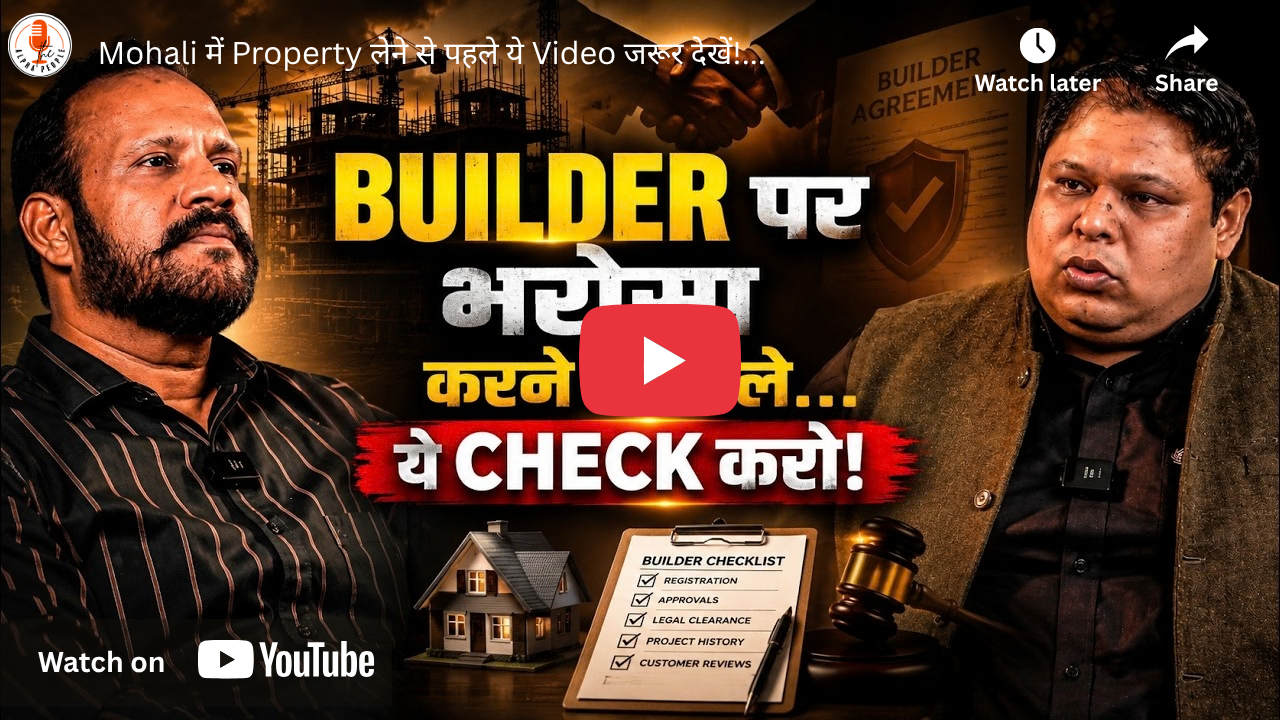
The discussion examines the evolving dynamics of the Tricity property market—encompassing Chandigarh, Mohali, and Kharar—highlighting both lucrative opportunities and hidden pitfalls for homebuyers and investors. A key emphasis is placed on establishing realistic expectations: promotional renders and sales brochures frequently paint an inflated picture of grandeur, but on-ground amenities and community facilities directly correlate with the capital invested per square foot. Buyers must align their lifestyle aspirations with their actual financial limits rather than chasing impractical commitments.
Due diligence emerges as the central pillar of secure real estate acquisition. While RERA compliance is standard practice today, it does not guarantee project completion on its own. The guest underscores the necessity of independent legal scrutiny, including visiting local revenue offices to pull title records, verifying whether the promoter holds debt-free ownership of the land bank, and checking for clear family consent among co-owners. Engaging banks for home loans—or opting for projects with formal Approved Project Financial status—serves as an effective risk filter because institutional lenders rigorously vet title chains before disbursing capital.
The conversation critiques common market practices that endanger buyer capital, specifically pre-launches, unrealistic construction timelines, and speculative commercial products. Projects sold prior to securing governmental sanctions frequently stall due to escalation in raw material costs like cement and steel. Furthermore, the market for speculative commercial real estate—such as under-construction malls, non-demarcated virtual spaces, and schemes offering upfront guaranteed returns—is flagged as high risk due to prohibitive maintenance costs and oversupply. Ready-to-move-in residential units or low-rise developments on secured land banks present far safer propositions.
Urban expansion patterns in the region are analyzed with respect to infrastructure. Unlike congested stretches with chronic bottlenecks, emerging corridors like the Kharar-Kurali highway and adjoining greenfield expressways offer robust multi-lane connectivity directly linked to state and national transit routes. These corridors are absorbing significant residential migration from neighboring states, particularly families seeking quality education, cleaner living, and proximity to Chandigarh. Infrastructure-backed arterial corridors offer sustainable appreciation compared to overburdened interior pockets.
Finally, the podcast addresses community living, post-possession property management, and long-term buyer responsibility. Gated residential societies require ongoing collective participation to maintain essential civic infrastructure, such as functional sewage treatment plants, power backup, and shared amenities. Prospective buyers are advised to prioritize clear title ownership, manageable density, and immediate or near-term possession timelines over distant, speculative projections.
🔔 Don’t forget to subscribe & share if this conversation resonated with you!
Frequently Asked Questions
Certainly! Here are some potential questions and answers based on the podcast conversation:
A professional advisor conducts essential legal and documentation checks, verifies seller family disputes, confirms 100% co-owner availability for signatures, negotiates realistic pricing, and prevents costly mistakes that buyers cannot foresee on their own.
Marketing renders present exaggerated, idealized imagery. Amenities reflect the actual budget and pricing of the development—a budget project will have modest facilities, while luxury-tier developments can afford elaborate clubhouses and gyms.
Pre-launches are often sold before statutory approvals and land registrations are finalized. Rising raw material and construction costs over the years often make original commitments commercially impossible, leading to stranded projects and developer defaults.
No. Many distressed and stalled projects held valid RERA certificates. Buyers must independently verify title deeds, revenue records (fard) via local revenue offices (Tehsil), and ascertain whether the developer owns the underlying land debt-free.
Reputed banks thoroughly scrutinize 30-year title chains, land records, building sanctions, and project approvals before issuing loans or granting Approved Project Financial (APF) status, providing buyers an added layer of institutional due diligence.
Properties directly situated on or adjoining national and state highways benefit from broader, better-maintained roads, reliable public transit, superior connectivity, and minimal municipal neglect compared to narrow interior settlement roads.
Enclosed malls involve significant transit hassle, steep basement parking times, high common area maintenance charges, and safety concerns, whereas open high-street SCO markets offer accessible parking, lower operational overheads, and quick pedestrian convenience.
Families migrating into the Chandigarh-Mohali region from neighboring states (such as Himachal Pradesh and Jammu) generally operate within realistic budgets, making 100 to 200 sq. yard configurations the most liquid and practical segment in the market.
Developers install Sewage Treatment Plants (STPs) as mandated by sanction guidelines, but resident welfare bodies and buyers often refuse to pay the recurring operational and maintenance costs required to keep machinery running continuously.
Virtual commercial spaces do not provide physical demarcation or separate boundary walls. If an entire floor or project underperforms, the buyer has no distinct physical asset to sell or lease independently, turning promised rental incomes into illusory guarantees.